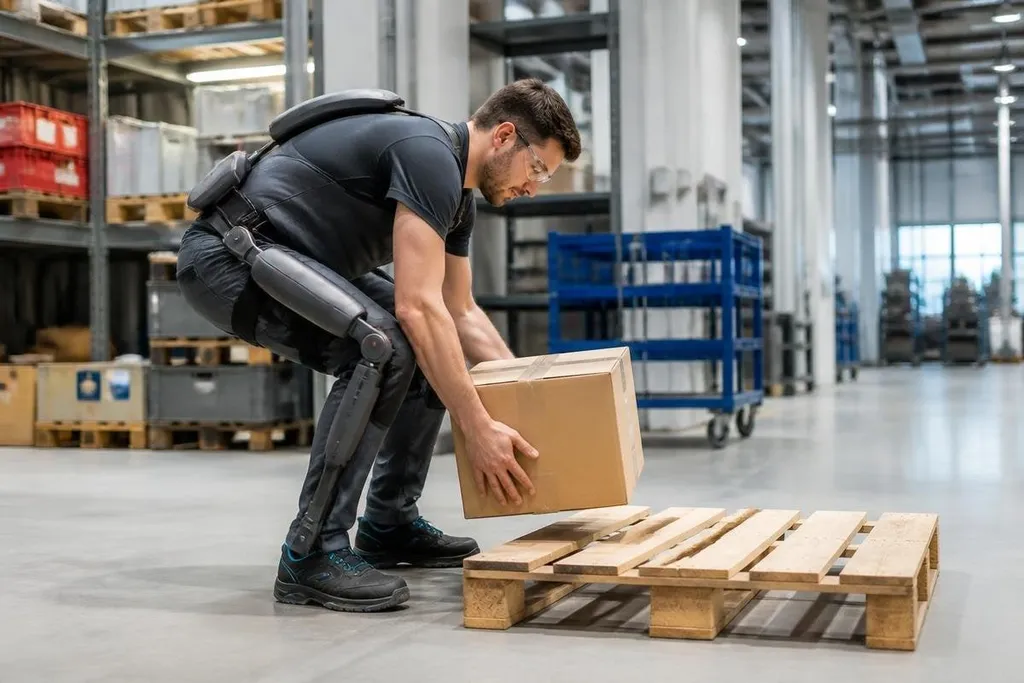
Exoskeleton robots may help a person lift, walk, or hold a position for longer. Their next stage will depend on one plain question: can they support real work without adding new problems for the wearer?
The broad direction is easier to see than the finish line. The machines must fit the body, react to movement, run for useful periods, and stop safely when something changes.
Quick read
- Exoskeletons need to follow the wearer’s movement rather than force a fixed motion.
- Battery size, weight, comfort, and control will shape where people can use them.
- Wider use will need evidence from repeated work, not one short demonstration.
The machine must follow the person
An exoskeleton sits between a person and a task. Motors, frames, sensors, and control software can add force to a joint or support part of the body, but the wearer still starts the movement.
That makes control a hard engineering problem.
The system has to detect what the person is trying to do, add the needed force, and stop adding force when the movement ends. A delay can make a lift feel awkward. An error can place pressure on the wrong joint.
The useful design will not be the one with the largest motor. It will be the one that gives the right help at the right moment while leaving the wearer in charge of the movement.
Weight and power set the limits
A wearable robot carries part of its own mass on the body. Batteries, motors, frames, and control hardware all take space and add weight. That creates a direct trade: more force can require more hardware, while more hardware can make the device harder to wear.
Power also shapes the task. A device meant for a short lift can have different limits from one used through a work period. Charging, battery changes, heat, and cable placement will affect how often the machine can leave its storage area and return to work.
This is why a laboratory demonstration cannot answer every buying question. The buyer needs to know how long the device can run, how much the wearer must carry, and what happens when the battery runs low.
Comfort is part of the control system
A frame can transfer force through the legs, back, or arms, but those contact points must stay in place as the body moves. Pressure, rubbing, restricted movement, or poor fit can turn useful support into a reason to stop using the device.
The problem grows when several people share one machine. Each wearer has a different body shape, stride, reach, and work habit. A setup process that takes too long can erase the time saved during the task.
A poor fit can shift pressure onto the hips, knees, or lower back, turning setup time into a safety issue. The evidence to check on Robot 24 is specific: the wearer group, task, test date, and measured force. That record leads into the next question: whether the robot stops safely when movement changes.
The safety case still needs proof
An exoskeleton can affect balance, joint motion, and the way a person reacts to a slip or sudden load. Safe operation therefore depends on more than a stop button. The system needs clear limits, predictable behavior, and a way for the wearer to remove or release it when needed.
The open question is how these machines perform after repeated use. A short test can show that a device moves. It cannot show how the device handles sweat, fit changes, worn parts, software faults, or a worker who moves in a way the designers did not expect.
I'd wait for repeated task evidence before treating any exoskeleton as ready for broad workplace use.
A practical buying check
Before you assess an exoskeleton robot for a real task, check these points:
- Name the task: record the lift, reach, walk, or hold that needs support.
- Measure the work period: match the required operating time to the device’s stated battery and charging setup.
- Check wearer fit: confirm how the frame adjusts and how long setup takes for each person.
- Test failure behavior: ask what the machine does after a sensor fault, low battery, or loss of power.
- Record human effort: watch for pressure, restricted movement, heat, and changes in posture during repeated work.
- Ask for task evidence: request results from the same type of work, not a different demonstration.
These checks point toward the likely shape of the market. Exoskeleton robots may first find work in narrow tasks where the motion is clear, the support need is repeated, and the safety limits can be tested closely. Broader use will need machines that adapt to people without making them manage the robot every few minutes.
The next useful proof is not a larger motor or a longer demonstration. It is a repeatable record of safe work over time.